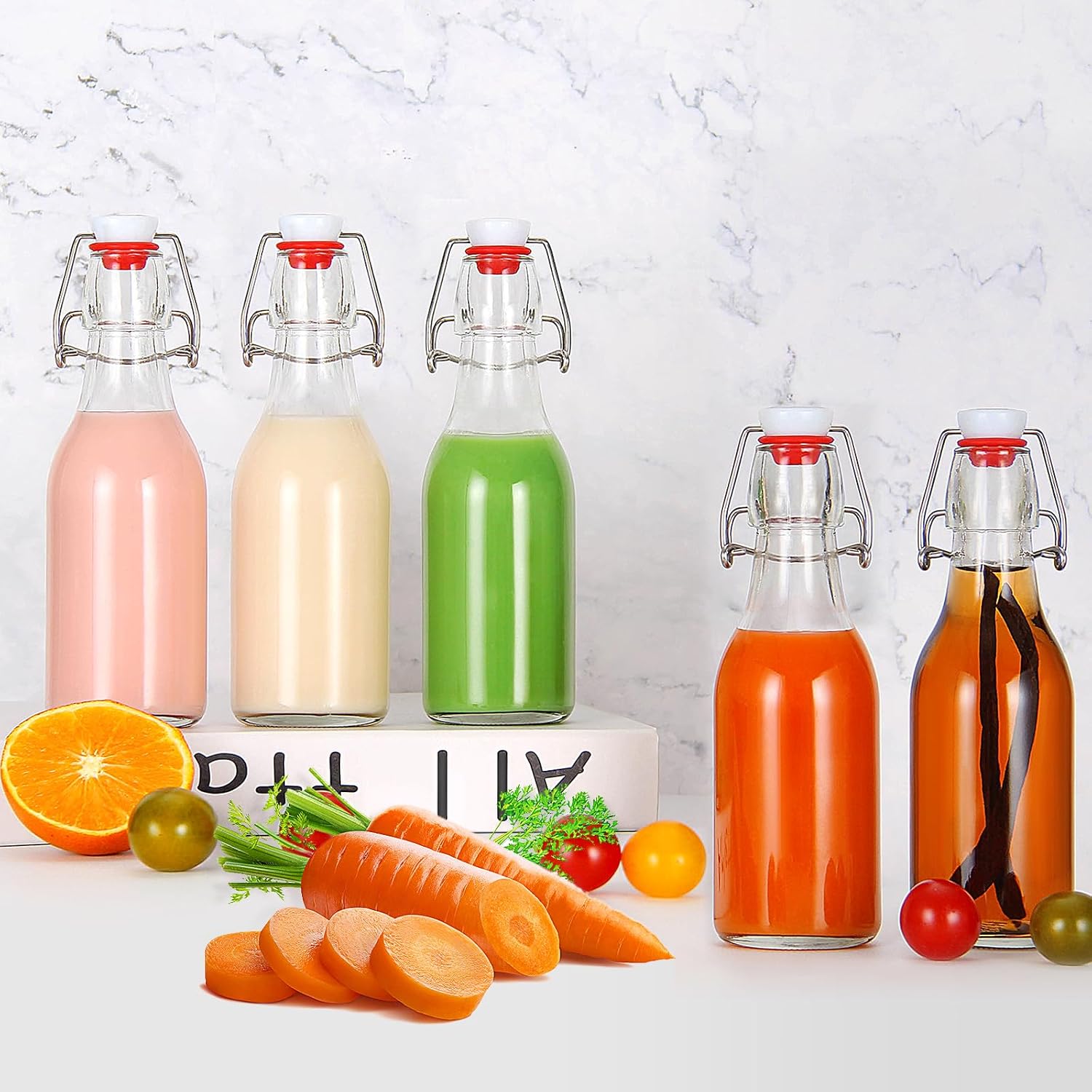
If you’ve ever bought a case of those old-fashioned glass bottles with the little wire-and-ceramic latch on top — that’s a swing-top bottle, sometimes called a Grolsch-style or bail-top bottle — you already know they look great on a counter and feel satisfying to open. What you might not know until the order arrives is whether you bought the right size. This guide exists because that mistake is extremely common: buyers consistently report in long-run reviews that they started with one size and ended up wishing they had another. Whether you’re bottling your first gallon of homemade kombucha (a fermented, lightly carbonated drink made from sweetened tea), filling pretty little jars of infused oil for holiday gifts, or stocking a home bar with sparkling mixers, the size of the bottle changes everything about how the process works. We’ve combed through aggregated buyer reviews, published fermentation guides, and spec sheets across the most popular swing-top options so you don’t have to start over after your first order.
| EDITOR'S PICKNevlers Swing Top Glass Bottles… | Mid-tierOtis Classic Swing Top Glass Bo… | Budget pickYEBODA 8oz Swing Top Bottles -… | |
|---|---|---|---|
| Bottle size | 16 oz | 16 oz | 8 oz |
| Pack count | 12 | 6 | 9 |
| Glass color | Amber | Clear | — |
| Marker included | — | ✓ | — |
| Labels included | — | ✓ | — |
| Cap material | — | Plastic | — |
| Price | $34.99 | $25.99 | $21.84 |
| See on Amazon → | See on Amazon → | See on Amazon → |
Why Size Is the Decision That Changes Everything
Let’s be direct: 8 oz, 16 oz, and 1-liter swing-top bottles are not interchangeable formats with different labels. They represent three genuinely different use cases, and choosing the wrong one doesn’t just cost you money — it changes how you manage carbonation pressure, how much batch planning you do, and whether recipients of your homemade gifts actually find the portion size useful.
The core tradeoff is headspace versus convenience. Headspace is the empty air gap between the liquid surface and the sealed cap. Less headspace means more CO₂ gets absorbed into your beverage, which produces stronger carbonation — a meaningful variable for anyone doing a second fermentation (the stage where kombucha gets its fizz, after the initial brew). More headspace gives carbonation room to build but can lead to over-pressurization if you let it go too long. The Kitchn’s guide on kombucha second fermentation specifically calls out bottle choice and headspace management as two of the most important variables in getting consistent results at home.
Here’s how the three sizes stack up on the dimensions that actually matter:
| Format | Typical Use Case | Headspace Behavior | Servings per Bottle |
|---|---|---|---|
| 8 oz | Gifting, samplers, shots | Tight; carbonates fast | 1 (small) |
| 16 oz | Kombucha batches, daily drinking | Balanced; most forgiving | 1–2 |
| 1 Liter | Sharing, sparkling water, mixer bottles | More variable; needs monitoring | 3–4 |
The 16 oz Case: Why Kombucha Brewers Keep Landing Here
If you’re doing kombucha second fermentation with any regularity, the 16 oz bottle is where the community lands almost universally — and the math explains why. A standard one-gallon kombucha batch yields almost exactly seven 16 oz bottles with minimal waste. Reviewers of the YEBODA 16 oz swing-top bottles cite this “one gallon, seven bottles” planning ratio repeatedly as the practical reason they settled on this size. It makes labeling, timing, and refrigerator organization predictable. You’re not doing awkward partial fills or stretching a batch across bottles of mismatched sizes.
Bon Appétit’s fermentation vessel overview notes that glass is strongly preferred over plastic for second fermentation because it doesn’t absorb flavor compounds and allows you to actually see what’s happening inside the bottle. The 16 oz glass format threads the needle between being portable enough to grab from the fridge and large enough that you’re not opening a fresh bottle every few sips.
Seal integrity is the other conversation that keeps coming up in this size category. Across aggregated reviews, buyers consistently distinguish between silicone and rubber stoppers — the gasket material that creates the airtight seal under the ceramic or plastic cap. Silicone gaskets hold up better over repeated dishwasher cycles and are generally rated to higher temperature tolerances; rubber gaskets are effective but can degrade faster with heat and acidic liquids like kombucha. If you plan to run bottles through the dishwasher regularly, look for bottles that ship with silicone seals and confirm replacement seals are available for purchase separately.
The 16 oz verdict: If you have a one-gallon kombucha setup and you’re bottling more than twice a month, this is the size to optimize around. Don’t overthink it.
The 1-Liter Case: Bigger Isn’t Always More Convenient
The 1-liter bottle is where buyers most commonly report second-guessing themselves — and then completely changing their opinion after living with the bottles for a few weeks.
In long-run reviews, the pattern is this: a buyer who ordered 1-liter bottles initially wonders if she made an ordering mistake, then discovers that she’s abandoned her 16 oz bottles almost entirely. Why? Sharing and convenience at the point of use. A 1-liter bottle placed on a table for dinner service, a party, or a cocktail mixing session functions like a proper carafe. You’re not running back to the fridge. For homemade sparkling lemonades, infused sparkling water, or premium mixer storage, the format just works better at the serving level.
The tradeoff is carbonation management. Serious Eats’ carbonation science overview explains that once a large-format bottle is opened, re-sealing with a swing-top works better than a screw cap but still loses CO₂ faster than a pressurized system. Buyers who’ve gone through multiple orders of 1-liter bottles note that taking precautions — specifically “burping” the bottles briefly during second fermentation to release excess pressure before resealing — is still necessary even with a good swing-top seal. That’s not a flaw in the bottles; it’s physics. The larger the volume, the more CO₂ is being generated, and the more you need to stay on top of pressure.
The Nevler amber 1-liter swing-top bottles come up specifically in home-brewer circles because the amber glass addresses a concern that doesn’t come up in every buying guide: UV light degrades certain flavor compounds and can affect fermentation. Reviewers who sought out these bottles report doing so after reading about glass thickness and light protection — the amber tint provides meaningful UV filtering that clear glass doesn’t. For anything you’re aging for more than a few days before drinking, that distinction matters.
The 1-liter verdict: Buy this size if you’re serving groups, storing sparkling mixers for a home bar setup, or want a format that doubles as a table-ready carafe. Plan to burp during active fermentation and consume within a day or two of opening.
The 8 oz Case: The Gifting Size That Earns Its Keep
The 8 oz swing-top bottle doesn’t make a lot of sense as a daily-use kombucha format — it’s too small for a satisfying pour and too many bottles to manage per batch. But it dominates an entirely different use case that reviewers bring up consistently: gifting.
Coquito (a Puerto Rican coconut cream holiday drink), infused oils, shrubs, homemade sodas, flavored vinegars — the 8 oz bottle is the format that turns a homemade product into something that looks intentional. Apartment Therapy’s guide to gifting homemade beverages highlights that portion size matters for perceived value: a recipient is more likely to try and finish an 8 oz bottle of something unusual than a 16 oz bottle, which can sit unopened in a cabinet for weeks out of intimidation.
From a carbonation standpoint, 8 oz bottles reach pressure quickly and can over-carbonate faster than larger formats, so they’re better suited to still beverages or products that will be consumed the same day. For effervescent gifting use cases like sparkling shrubs or homemade sodas intended to be opened right away, the tight headspace can actually work in your favor by delivering more pop on first opening.
The 8 oz verdict: If gifting is your primary use case, buy here. If you want to use them for kombucha batches, plan to burp frequently and label your fill dates clearly.
By the Numbers
- 1 gallon kombucha batch → 7 bottles at 16 oz (near-zero waste)
- 1 gallon → 16 bottles at 8 oz (high management overhead)
- 1 gallon → 3.8 bottles at 1 liter (partial final bottle; works best topped off)
- Reviewers who’ve placed 6+ repeat orders of the same bottle consistently cite seal reliability and gasket replaceability as the features that drove repurchase
The Decision Rules (If X, Then Y)
You’ve read the tradeoffs. Here’s the clean version:
If you’re bottling kombucha from a one-gallon home batch on a recurring schedule: Buy 16 oz. The math is clean, the format is forgiving, and the community has built its best practices around this size. YEBODA’s 16 oz bottles are the most-cited option in long-run kombucha reviews.
If you’re setting up a home bar or want bottles that work as serving carafes: Buy 1-liter. Accept that you’ll need to monitor carbonation during second fermentation, but enjoy the format’s practicality at the table. If UV protection matters to your recipe (anything with hops, certain fruit profiles), look specifically at the Nevler amber option.
If your primary use case is gifting homemade beverages: Buy 8 oz. The portion size is right for recipients, the format looks considered, and the carbonation concern is minimal if you’re gifting still products or anything consumed on the day of gifting.
If you’re unsure: Buy a mixed case of 16 oz and spend one batch figuring out whether you wish you had gone bigger or smaller. Virtually every experienced home brewer who’s been at this for more than six months has done exactly this, and it’s a far cheaper lesson than ordering sixty bottles of the wrong size.
Frequently Asked Questions
What size swing-top bottle is best for kombucha second fermentation? Most home brewers land on 16 oz after trying other sizes. It produces the most predictable batch-to-bottle math and gives you enough headspace to build carbonation without over-pressurizing as quickly as smaller bottles.
Can swing-top bottles handle carbonation pressure safely? Yes, with active management. The wire bail and ceramic stopper create a strong seal, but carbonation will build under fermentation, and all formats benefit from periodic “burping” — briefly opening and resealing — to release excess pressure. Reviewers who have used 1-liter bottles across many batches note this step as standard practice, not a workaround.
Are these bottles dishwasher safe? Most swing-top bottles are rated dishwasher safe, but the gasket material matters. Silicone seals tolerate repeated high-temperature cycles better than rubber. Check the product listing for gasket material, and buy replacement seals when you order your bottles so you’re not searching for them six months later.
What is the difference between silicone and rubber stoppers? Both create an airtight seal under the swing-top latch. Silicone is more heat-resistant, less likely to absorb flavors from acidic liquids, and generally holds up longer over repeated dishwasher cycles. Rubber is effective but can degrade faster, especially with acidic beverages like kombucha or vinegar-based shrubs.
How many bottles do I need for a one-gallon kombucha batch? Seven 16 oz bottles with minimal waste. Eight if you tend to leave a small amount behind in your brewing vessel. For 1-liter bottles, plan for four with a partial fill on the last one.
Can I use these bottles for gifting homemade beverages? Absolutely — and the 8 oz format is the most-cited size for gifting. Reviewers mention coquito, infused oils, and homemade sodas as the most common gift applications. The format looks deliberate, the portion is approachable, and the swing-top mechanism adds a tactile quality that recipients respond to positively.