If you’ve walked down a grocery aisle or scrolled through a grocery delivery app lately, you’ve almost certainly seen cans with phrases like “gut-healthy,” “prebiotic fiber,” or “supports your microbiome” printed right alongside the fizzy soda branding. These are prebiotic sodas — carbonated drinks that add plant-based dietary fibers (called prebiotics, meaning ingredients that feed the beneficial bacteria already living in your digestive system, rather than adding new bacteria the way probiotics do) to a recipe that otherwise looks a lot like a normal flavored sparkling beverage. The pitch is appealing: get your soda fix and nudge your gut health in the right direction at the same time.
But the label language in this category is notoriously slippery. “Supports digestive health,” “gut-friendly fiber,” and “clinically studied ingredients” can mean very different things — or sometimes almost nothing at all from a regulatory standpoint. This article reads the fine print on three specific products — OLIPOP, Bloom Pop, and Pepsi’s own prebiotic entry — compares what each label actually promises against what the published science says, and gives you a clear decision frame for whether the premium price is justified for your pantry, your event bar, or your retail shelf.
What “Prebiotic” Actually Means on a Soda Label (and What It Doesn’t)
Let’s start with the regulatory reality, because it shapes everything downstream.
In the United States, a beverage sold as a conventional food (not as a dietary supplement) is governed by FDA labeling rules. Per the FDA’s guidance document “Label Claims for Conventional Foods and Dietary Supplements,” there are three tiers of health claim:
- Authorized health claims — require significant scientific agreement and FDA pre-approval. Rare and tightly worded.
- Qualified health claims — allowed with a disclaimer noting the evidence is limited. More common in supplements, uncommon on soda cans.
- Structure/function claims — the most permissive category. A phrase like “supports digestive health” or “contains prebiotic fiber” simply has to be truthful and not misleading. The brand does not need FDA approval to use it.
Almost every prebiotic soda on the market uses structure/function claims exclusively. That’s not inherently deceptive — it just means the label is making a claim about what an ingredient does in the body in general terms, not that this specific product has been proven to deliver a clinical outcome at the dose in the can. When you see “supports your microbiome,” you are reading a structure/function claim, full stop.
The International Scientific Association for Probiotics and Prebiotics (ISAPP) published a consensus definition in 2017 establishing that a true prebiotic must be “selectively utilized by host microorganisms conferring a health benefit.” The key word is selectively — the fiber has to actually feed beneficial bacteria, not just any bacteria. Common prebiotic fibers that meet this standard include inulin, fructooligosaccharides (FOS), chicory root fiber, and cassava root fiber.
As Healthline’s overview of prebiotics notes, most peer-reviewed studies on prebiotic efficacy use doses in the range of 3–8 grams per day to show measurable changes in gut microbiome composition. That number matters when we look at what’s actually in each can.
OLIPOP: The Market Leader’s Label, Decoded
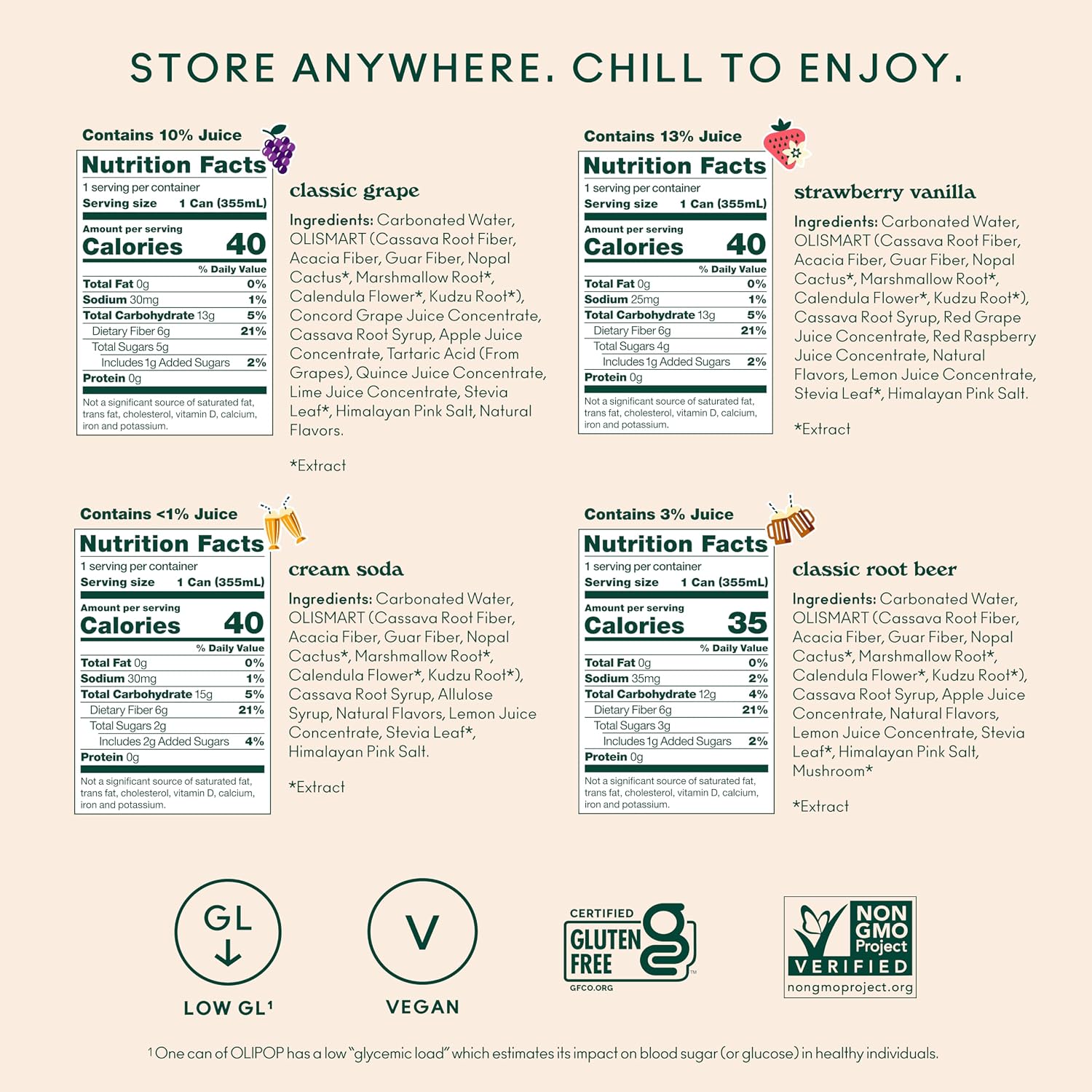
OLIPOP is the brand that effectively created the mainstream prebiotic soda category in the U.S. and remains its best-recognized name. A standard 12 oz. can carries 9 grams of dietary fiber, drawn from a proprietary “OLISMART” blend that includes cassava root fiber, chicory root inulin, Jerusalem artichoke inulin, kudzu root, calendula flower, and marshmallow root.
What the label promises: OLIPOP uses the phrase “supports digestive health” and prominently displays the fiber content. It does not make an authorized health claim. The brand’s website and marketing lean heavily on the OLISMART formulation being “clinically studied,” but the study referenced on their site (as of early 2026) is an in-house-commissioned pilot study — meaningful preliminary data, but not the kind of large, peer-reviewed, independently funded RCT that would satisfy a researcher.
What the numbers actually say:
By the numbers — OLIPOP 12 oz. can Dietary fiber: 9 g (32% of Daily Value) Added sugars: 2–5 g depending on flavor Calories: 35–45 Cost per can (specialty retail / DTC): approximately $2.49–$2.99
The 9-gram fiber figure is genuinely notable. If OLIPOP were your only source, you’d fall short of that 3–8 g/day study-range threshold just from one can — but you’d also be meaningfully closer than most mainstream sodas, which deliver zero prebiotic fiber. Bon Appétit’s feature “Is OLIPOP Actually Good for You?” reached a similar conclusion: the fiber dose is real and not trivial, but the clinical leap from “this fiber is beneficial in studies” to “drinking this can delivers those benefits” is one the brand implies more strongly than the evidence strictly supports.
The honest tradeoff: If you’re buying OLIPOP for flavor complexity and low sugar versus mainstream soda, it earns its place easily. If you’re buying it because you believe it will meaningfully shift your gut microbiome based on one or two cans a day, you’re extending the claim further than the label or the current science can fully back.
Bloom Pop and the Second-Wave Challengers
Bloom Pop entered the prebiotic soda space as part of a wave of challengers that followed OLIPOP and Poppi’s breakout years. Its positioning skews slightly younger and more social-media-forward, and its fiber sourcing relies primarily on inulin derived from chicory root — one of the best-studied prebiotic fiber sources available.
What the label promises: Bloom Pop’s cans typically state “prebiotic fiber” and “gut health support.” The chicory-root inulin sourcing is disclosed on ingredient panels, which is a mark of transparency relative to proprietary-blend language. However, per-can fiber content sits lower than OLIPOP — generally in the 4–6 gram range depending on the SKU — and the brand’s clinical citations, as reported in Eater’s feature “The Rise of Functional Soda,” are drawn from third-party inulin studies rather than product-specific trials.
The honest tradeoff: The ingredient is well-studied; the product is less differentiated. For buyers who care about the sourcing pedigree of their prebiotic fiber, chicory-root inulin has a deeper published evidence base than some of the more exotic roots in proprietary blends. Whether you want to pay the prebiotic premium for a brand with less retail footprint is a different question.
Pepsi’s Prebiotic Entry: What a Legacy Brand’s Label Looks Like
PepsiCo’s move into the prebiotic category (via its Soulboost line and adjacent product development) illustrates exactly how mass-market labels stretch functional language to its limits.
What the label promises: Legacy-brand prebiotic entries tend to use the lightest possible functional language — “with prebiotic fiber” or “contains inulin” — and the fiber dose is typically at the low end of the spectrum, often 2–3 grams per serving. This is a legally clean structure/function claim: the ingredient is there, prebiotics do support digestive health in research contexts, therefore the claim is truthful but not misleading.
What it is not is a dose that most published studies would identify as physiologically significant. VinePair’s industry overview “Inside the Functional Beverage Boom” noted that mass-market functional beverages frequently use “fairy dusting” — adding an ingredient at a dose low enough to be cost-effective but too low to replicate what studies used. The FDA does not regulate minimum effective doses for structure/function claims on conventional foods, so this is entirely legal.
The honest tradeoff: If the primary draw is familiar flavor + a marginal health halo for shoppers already buying the brand, the label delivers. If the primary draw is meaningful prebiotic fiber intake, the dose math doesn’t compete with the category specialists.
The Decision Frame: If X, Then Y
Here’s where the rubber meets the road for practitioners stocking a pantry, curating an event bar, or advising a boutique retail buyer.
If your buyer prioritizes demonstrated fiber content and is comfortable with a proprietary-blend formulation: → OLIPOP is the defensible choice. The 9-gram fiber figure is real, the brand has the most market recognition to justify premium shelf placement, and the flavor library is wide enough to anchor a curated selection.
If your buyer is ingredient-literate and wants the most studied prebiotic source in a transparent formulation: → Bloom Pop’s chicory-root inulin sourcing is a legitimate differentiator. You give up some brand recognition; you gain a cleaner “why this ingredient” story for an educated audience.
If you’re stocking a high-volume event bar or gifting variety pack and need accessible price-per-unit while still offering a “functional” option: → A mass-market prebiotic entry handles the volume math. Know that the functional claim is thinner, and position it accordingly — don’t lead with health benefits if the dose doesn’t back it up.
If the gut-health claim is the primary purchase driver for your customer: → Be honest in your curation. No single daily prebiotic soda can replicate the outcomes of the dietary intervention studies. The best candidate in the category gets you to a meaningful fiber contribution, not a clinical outcome. Frame it that way and you build trust; frame it as medicinal and you’ll eventually lose it.
The broader takeaway, consistent across Eater’s reporting, Bon Appétit’s analysis, and VinePair’s category deep-dives: prebiotic sodas occupy a real and defensible space between empty-calorie mainstream soda and the supplement aisle. The brands doing it best are transparent about fiber sourcing and dose. The label language across the category outruns the clinical evidence — and understanding that gap is exactly what separates a practitioner from a credulous shelf-stocker.
Read the fiber panel, check the source ingredient, and match the dose to your buyer’s expectations. That’s the whole job.