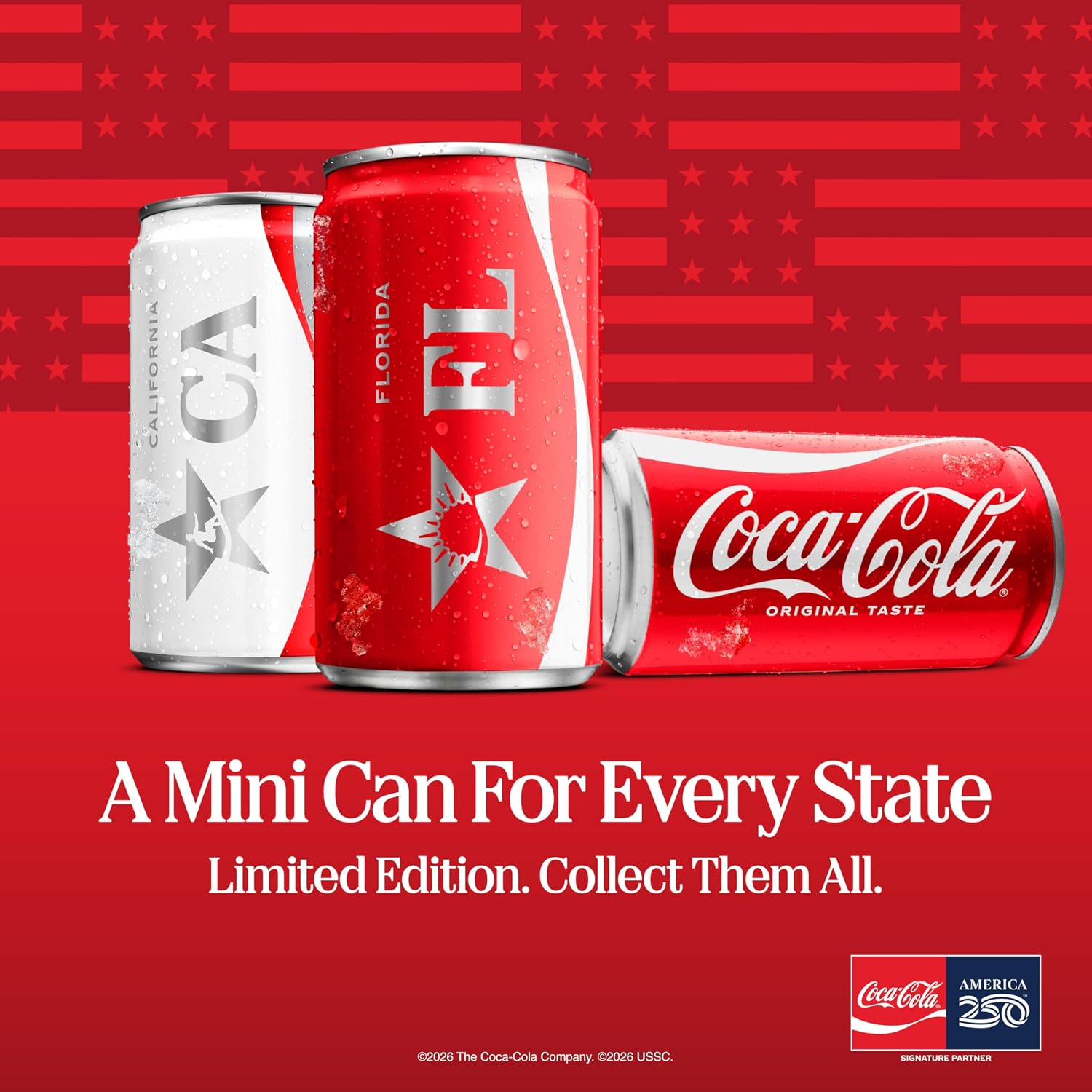
If you’ve ever grabbed a cute little 7.5-oz mini can of Coke at the checkout aisle and thought, “That seems kind of expensive for such a tiny drink,” your instincts were right — and they’re worth following through on. A mini can is simply a smaller-format version of a standard 12-oz aluminum can: same cola, less liquid, different package. Soda companies now sell these in formats ranging from 7.5 oz (the most common “mini”) to 8 oz and even 10 oz, usually bundled into 10- or 15-packs. The pitch from the brands is portion control and less waste. The reality, once you run the numbers, is that you’re often paying a 30–70% premium per ounce compared to a standard 12-pack. This guide breaks down that math across Coca-Cola, Pepsi, and Dr Pepper, explains when the premium actually makes sense, and gives you clear rules for deciding which format to buy depending on how you’re using the soda.
| EDITOR'S PICKCoca-Cola Fridge Pack Soda Soft… | Mid-tierCoca-Cola Zero Sugar Soda Soft… | Budget pickPepsi Wild Cherry Cola Soda Pop… | |
|---|---|---|---|
| Pack size | 12 | 12 | 10 |
| Can size | 12 fl oz | 12 fl oz | 7.5 fl oz |
| Total volume | 144 fl oz | 144 fl oz | 75 fl oz |
| Flavor | Classic Cola | Zero Sugar Cola | Wild Cherry |
| Fridge pack | ✓ | ✓ | — |
| Mini cans | ✗ | ✗ | ✓ |
| Price | $8.89 | $8.42 | $5.97 |
| See on Amazon → | See on Amazon → | See on Amazon → |
The Per-Ounce Math Nobody Prints on the Label
Let’s do the work the packaging won’t.
Retail pricing across major online channels in May 2026 shows the following approximate ranges for the most common configurations of mainstream cola brands (prices will vary by retailer and region, but the ratios hold consistently):
By the numbers — approximate cost per ounce, standard vs. mini format:
| Format | Typical Pack | Approx. Retail Price | Cost per Oz |
|---|---|---|---|
| Coca-Cola Classic, 12-oz cans | 24-pack | $9.99–$12.99 | ~$0.035–$0.045 |
| Coca-Cola Classic, 7.5-oz mini cans | 10-pack | $5.49–$6.99 | ~$0.073–$0.093 |
| Pepsi, 12-oz cans | 24-pack | $9.99–$11.99 | ~$0.035–$0.042 |
| Pepsi, 7.5-oz mini cans | 10-pack | $5.49–$6.99 | ~$0.073–$0.093 |
| Dr Pepper, 12-oz cans | 24-pack | $9.99–$12.49 | ~$0.035–$0.043 |
| Dr Pepper, 7.5-oz mini cans | 10-pack | $5.49–$6.79 | ~$0.073–$0.090 |
The pattern is almost perfectly consistent across all three brands: you’re paying roughly 2x per ounce for the mini format. Consumer Reports’ grocery unit-price guidance makes exactly this point — the smaller the package, the higher the unit price almost universally, and carbonated beverages are not exempt from this rule.
Beverage Digest’s U.S. Carbonated Soft Drink Volume and Package Mix Report from 2025 confirms that small-format cans (defined as sub-10-oz) have been the fastest-growing package segment by dollar volume even as overall cola volume has stayed flat — meaning manufacturers are capturing more revenue per ounce sold, not selling more liquid. That’s the business case for mini cans, stated plainly.
Where the Premium Goes (It’s Not What You Think)
The obvious assumption is that smaller cans cost more because they use more aluminum per ounce of liquid — more cans, more lids, more seaming. That’s partially true. But Circana (formerly Nielsen IRI) data on small-format beverage trends from Q4 2025 shows something more interesting: the premium is largely positional, not structural. Mini cans are shelved differently, marketed differently, and purchased by a different shopper at a different moment than standard 24-packs.
Standard 24-packs are a pantry-stocking purchase. Shoppers compare unit prices, load them into Subscribe & Save, and optimize ruthlessly. Mini cans are an impulse aisle product, a party-table product, a bar-cart product. When a 10-pack of mini Cokes sits next to a bottle of bourbon at a dinner party, nobody is running ounce-price comparisons.
That’s the mechanism the brands are exploiting — not deception, exactly, but a deliberate format-to-context match that happens to increase margin dramatically. Eater’s analysis of the premium soda format market makes this point directly: mini cans succeeded commercially not because they offered more value per dollar, but because they slotted into occasions where value-per-dollar wasn’t the purchase driver.
Understanding this is the key decision frame for practitioners. The question isn’t “are mini cans a rip-off?” It’s “am I buying for an occasion where the format premium is justified, or am I leaving money on the table?”
Three Scenarios Where Mini Cans Are Actually Worth It
1. Bar and cocktail mixer applications
This is the use case where mini cans pay off most cleanly. VinePair’s coverage of the cocktail mixer economy notes that portion control is functionally important in bar settings: a 7.5-oz can is close to a single-serve cocktail build, you open it, you use it, there’s no leftover flat cola sitting in a pour spout. In a home bar or event-catering context, the premium is real but the waste reduction is also real.
For comparison: premium mixers like Q Mixers Tonic Water and Fever-Tree come in 6.8-oz bottles and retail for $1.50–$2.00 per unit. A mini cola at $0.55–$0.70 per can looks reasonable in that company, even if it’s expensive relative to a standard 12-oz can.
If you’re stocking a bar cart for a party and pricing per drink built rather than per ounce, mini cans are competitive with mixer alternatives and give you the brand legibility guests recognize (a Coke can on a bar table signals something a splash of cola from a two-liter does not).
2. Households managing consumption
The brands’ portion-control pitch has genuine merit for households that consistently open a 12-oz can and pour half of it out or let it go flat. If your real-world consumption is 6–8 oz per sitting, the effective waste on a 12-oz can is 33–50%. Run that math: if you’re wasting four ounces of every 12-oz can, your effective cost per consumed ounce on the standard format climbs substantially, narrowing the gap with mini cans.
This isn’t a reason to always buy minis — it’s a reason to be honest about actual consumption patterns before defaulting to “bigger is always cheaper.”
3. Event gifting and visual presentation
Mini cans in a branded 10-pack have a visual cleanliness that works in charcuterie-style beverage displays, custom cooler presentations, and party gift bags. The packaging itself has aesthetic value for the occasion. If you’ve priced custom event beverages — imported European sparkling lemonades at $5–$8 per bottle, curated international variety packs at $30–$60 — a $6.99 10-pack of mini Cokes is actually economical in the premium events context.
When Mini Cans Are a Straightforward Waste of Money
Everyday household consumption. If you’re buying soda as a refrigerator staple for a household that drinks it regularly over ice in full servings, mini cans are an expensive habit. A household going through 3–4 cans a day will pay meaningfully more per year buying minis versus Subscribe & Save 24-packs. The math is not close.
Large-format entertaining. If you’re hosting 20 people and serving soda as a mixer or standalone drink in a cooler, standard 12-oz cans or 2-liter bottles win decisively on cost per serving. Mini cans in this setting provide no format benefit — portions aren’t a concern when you’re filling cups with ice — and the cost premium is pure waste.
Stocking up “just in case.” The mini can’s only format advantages (portion control, single-serve freshness) disappear in bulk-storage scenarios. Buy the 24-pack, keep it cool, and open cans as needed.
Brand-Specific Notes: Does the Flavor Hold Up in Small Format?
One question that comes up in dedicated soda communities: do 7.5-oz mini cans taste different from 12-oz standard cans of the same brand?
Across aggregated review threads on dedicated beverage forums and buyer commentary compiled by Eater, the consistent finding is that carbonation intensity is perceived as slightly higher in mini cans by many drinkers. This is likely a surface-area-to-volume ratio effect — less headspace, slightly different carbonation equilibrium when opened. The effect is subtle but noticeable to flavor-attentive drinkers.
For Coca-Cola Classic, this tends to read as a crisper, slightly more aggressive initial sip — fine for cocktail mixing, potentially less ideal if you prefer the softer carbonation of a fully opened standard can that’s been poured over ice.
For Pepsi, reviewers note the higher-perceived-carbonation effect less dramatically; Pepsi’s formulation already reads as slightly sharper than Coke to many palates, and the mini format doesn’t noticeably amplify it.
For Dr Pepper, the dense 23-flavor profile is reported by tasting-focused reviewers at publications like Tasting Table to hold up well in small format — the complexity reads consistently regardless of can size, and the mini format’s higher carbonation actually enhances the initial flavor pop that Dr Pepper is known for.
None of these are disqualifying differences. But if you’re selecting format for a specific sensory application — say, a cola-forward cocktail where carbonation intensity matters — it’s worth knowing the mini format tends to skew sharper.
The Decision Rule
Here’s the if/then framework for buying mini cans versus standard format:
If you’re stocking for everyday household drinking → buy the 24-pack standard format on Subscribe & Save. The per-ounce savings are 50%+ and compound significantly over time.
If you’re running a bar cart, building cocktails, or catering an event where single-serve portions matter → mini cans earn their premium. The format aligns with the use case and the waste reduction is real.
If you’re entertaining a large group and serving soda as a standalone drink → skip minis entirely. Standard 12-oz cans or 2-liters win on cost-per-cup delivered.
If you’re building a gifting display, a premium beverage table, or a branded party presentation → mini cans in branded 10-packs are a reasonable buy. The visual value and brand clarity are genuine in this context.
The mini can is not a scam — it’s a product designed for a specific set of occasions where the 2x per-ounce premium is functionally or aesthetically justified. The error practitioners make is buying for the wrong occasion because the packaging looks appealing or the absolute price point feels low. A $6.99 10-pack of mini Cokes feels cheaper than a $11.99 24-pack of standard cans right up until you do the ounce math and realize you’re buying less than half the liquid for 58% of the price.
Run the numbers. Match the format to the occasion. And if you’re building a bar cart worth showing off, the mini can earns a legitimate spot — just don’t confuse “worth it for this occasion” with “a good deal per ounce,” because it is definitively not the latter.