If you’ve ever stood in a grocery aisle staring at a green-and-gold can labeled “Aranciata” (that’s Italian for orange drink) next to a bottle of plain sparkling water with the same brand name and wondered whether those two products are even from the same company — yes, they absolutely are. San Pellegrino, the Italian brand founded in 1899 and now owned by Nestlé Waters, makes a surprisingly wide portfolio: mineral water, fruit-flavored sodas in the classic tall cans, a zero-sugar sub-line, a newer canned format, and premium sparkling lemonades that show up on cocktail menus and in upscale variety packs. If you’re stocking a home bar, building out a gifts-and-mixers order, or just trying to understand what to actually buy and where, this guide lays out every major line, names the tradeoffs, and ends with a clear decision tree so you can stop second-guessing.
| EDITOR'S PICKSanpellegrino Italian Sparkling… | Mid-tierSanpellegrino CIAO! Blood Orang… | Budget pickSanpellegrino CIAO Cherry Spark… | |
|---|---|---|---|
| Flavor | Orange & blood orange | Blood orange | Cherry |
| Added sugar | — | 0g | 0g |
| Calorie level | — | Low-cal | Low-calorie |
| Real fruit juice | — | — | ✓ |
| Bottle size | 11.15 fl oz | — | — |
| Price | $25.99 | $18.37 | $15.97 |
| See on Amazon → | See on Amazon → | See on Amazon → |
The Core Portfolio at a Glance
San Pellegrino’s product family breaks cleanly into four tiers. Understanding the separation helps you order with intention rather than grabbing whatever’s cheapest per can.
1. S.Pellegrino Sparkling Natural Mineral Water The plain mineral water — the green glass bottle with the red star — is its own product and its own conversation. It’s drawn from a spring in the Italian Alps in San Pellegrino Terme and carries a specific mineral profile (notably higher in calcium and sulfate than something like Topo Chico) that makes it taste distinctly “Italian fizzy water” rather than neutral. VinePair’s guide to Italian sparkling waters notes that S.Pellegrino’s mineral content gives it a slightly harder, more complex mouthfeel than domestic sparkling waters, which is why it holds its own alongside a full meal and became a restaurant-table staple in the first place. Format options: the iconic 750ml glass bottle, a 500ml glass bottle, and 1-liter glass for table pours. There are also PET plastic bottles, but the glass format is what the product is actually known for.
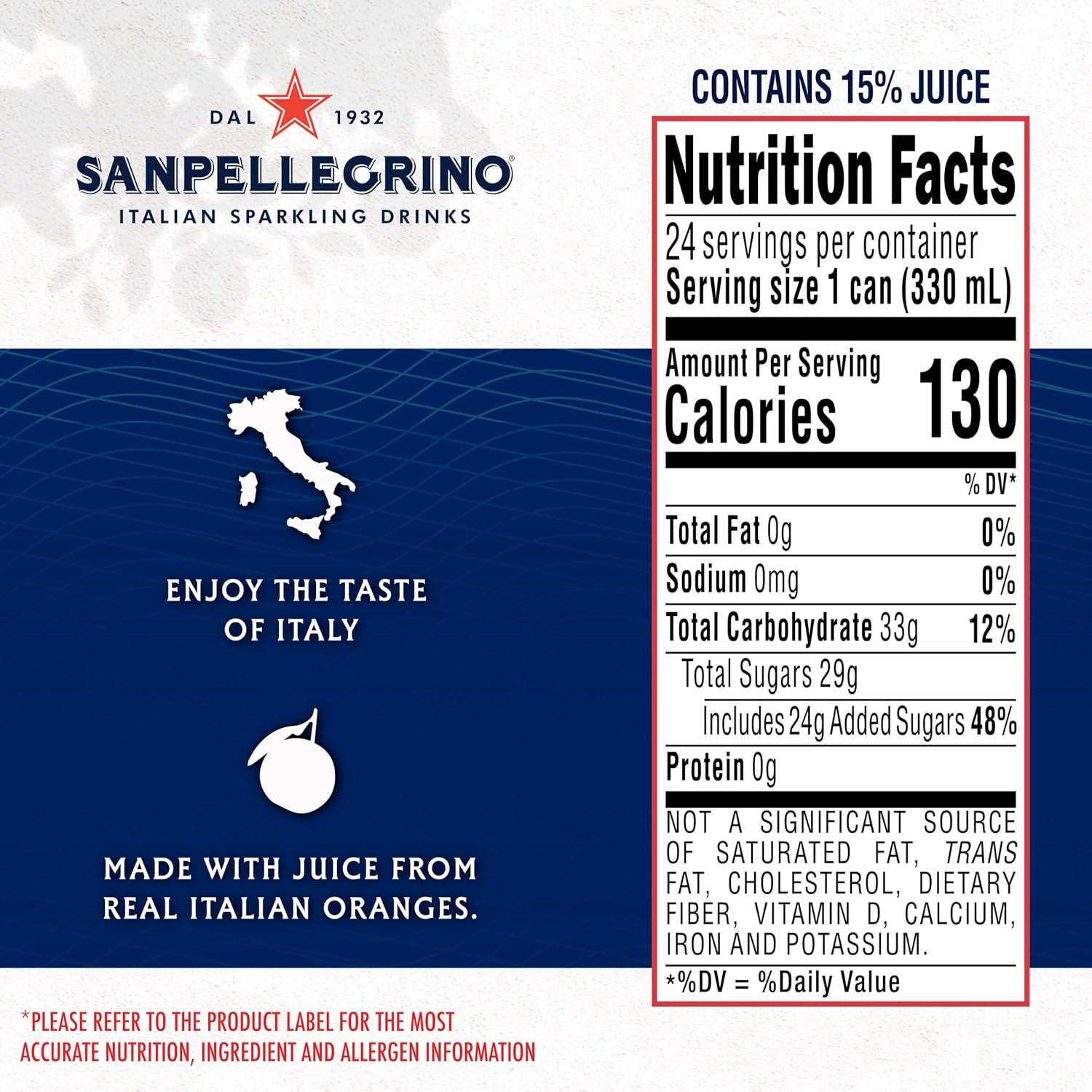
2. Sanpellegrino Sparkling Fruit Beverages (the classic tall cans) These are the products most people picture when they hear the San Pellegrino brand in a soda context: the 11.15 oz (330ml) tall cans in flavors like Aranciata (orange), Aranciata Rossa (blood orange), Limonata (lemon), Pompelmo (grapefruit), Melograno e Arancia (pomegranate and orange), and a few seasonal or market-specific additions. The key facts most buyers overlook: these use real fruit juice — the Aranciata Rossa, for example, contains Sicilian blood orange juice as a listed ingredient — and they are lightly carbonated compared to American sodas. They are also meaningfully sweet; a can of Limonata runs roughly 23 grams of sugar. Tasting Table’s ranking of the Sparkling Fruit Beverage line praises the Aranciata Rossa and Limonata specifically for flavor authenticity, noting that the juice content makes them taste more like a premium soda than a fruit-flavored fizzy water.
3. Sanpellegrino Zero Sugar Line (Aranciata Zero, Limonata Zero) Launched as a direct response to the functional-soda wave, the Zero Sugar sub-line uses a blend of sweeteners (primarily sucralose and acesulfame potassium, per the product label) to hit zero added sugar without abandoning the juice-forward flavor profile. The Nestlé Waters brand fact sheet for S.Pellegrino confirms that the zero-sugar variants still contain fruit juice, which distinguishes them from pure artificially-flavored diet sodas. The tradeoff is real: sweetener aftertaste is more present here than in the full-sugar versions, and the carbonation feels slightly thinner across aggregated reviews on retail platforms. These are a legitimate option for calorie-conscious buyers or for cutting drink calories at events, but they’re not a one-to-one substitute for the originals in a cocktail application.
4. CIAO by Sanpellegrino CIAO is the newest line (launched 2022, expanded through 2024–25), designed for everyday grab-and-go consumption. The format is a 330ml slim aluminum can with a more assertive carbonation level than the classic tall cans, positioned squarely at the functional/better-for-you segment: no artificial colors, no artificial sweeteners, real fruit juice, lower sugar than the classic line (typically 8–12g per can depending on flavor), and a slightly more modern flavor range that includes variants like blood orange and yuzu. Food & Wine’s roundup of cocktail and mocktail mixers has flagged CIAO as a usable mixer for lighter gin and vodka applications specifically because the carbonation is more persistent than the classic tall-can line.
By the Numbers
| Line | Size | Sugar (approx.) | Juice? | Best Use |
|---|---|---|---|---|
| S.Pellegrino Sparkling Water | 500ml / 750ml glass | 0g | No | Table water, spirits diluent |
| Classic Tall Can (e.g., Aranciata) | 330ml can | 22–27g | Yes | Standalone sipping, premium mixer |
| Zero Sugar | 330ml can | 0g | Yes | Calorie-conscious drinking |
| CIAO | 330ml slim can | 8–12g | Yes | Everyday drinking, lighter cocktails |
Where the Tradeoffs Actually Live
Classic Cans vs. CIAO: The Mixer Decision
If you’re buying San Pellegrino specifically as a cocktail mixer — for a Aperol situation, a bitter-spirit highball, or a nonalcoholic pairing — the classic tall can and the CIAO serve meaningfully different functions, and it matters which you stock.
The classic Aranciata and Limonata have more residual sweetness and lower carbonation, which makes them forgiving in a mix: they don’t blow out the bubbles when you pour over ice and add a spirit, and the extra sugar can compensate for a drier base. Serious Eats has noted in its sparkling water and mixer coverage that lower-carbonation sodas are often the smarter choice for cocktail builds because they survive the pour-and-stir process better. The tradeoff is that the higher sugar load means your drink reads sweet if your base spirit is also sweet.
CIAO’s higher carbonation and lower sugar makes it behave more like a premium tonic or a lemon sparkling water mixer. You get more lift and more effervescence in the finished glass, but less sweetness buffering. For drier applications — a gin and CIAO Blood Orange, for instance, or a mezcal highball where you want citrus without cloying sweetness — CIAO is the better call.
Decision rule: If you’re mixing with sweet liqueurs or building boosted mocktails, classic tall cans. If you’re mixing with dry spirits and want the carbonation to do work, CIAO.
Glass Bottle Water vs. Canned Formats: The Event and Gifting Math
For home entertainers building a drinks station or a restaurant buyer sourcing table water, the glass bottle is the presentation play. There is no meaningful flavor difference between the 750ml glass and a PET bottle of S.Pellegrino, per the brand’s own product documentation, but the glass bottle signals intent in a way that a plastic bottle does not. The per-ounce cost on glass is higher — typically 20–35% more than the PET equivalent based on retailer pricing available in May 2026 — but buyers in this segment consistently report that the visual of a green glass bottle on a table or in a gift arrangement reads as a premium touch that a plastic bottle simply doesn’t deliver.
For gifting specifically: the classic tall cans pack and ship well, stack neatly in mixed variety packs, and photograph beautifully. Several importers and specialty beverage retailers on platforms like Goldbelly and Beverages Direct offer curated San Pellegrino variety packs that include a mix of classic flavors and sometimes a CIAO or Zero introduction set. These packs typically run $28–$45 depending on count and sourcing, positioning them as a solid mid-tier gift above a grocery-store 12-pack but well below a full premium craft soda curation.
The Zero Sugar Line: When It Makes Sense (and When It Doesn’t)
The Zero Sugar line’s value proposition is specific. It makes sense if: you’re serving a mixed group where some guests are calorie-counting and you want everything to feel cohesive rather than serving a separate “diet” option; you’re building a zero-proof mocktail where you control sweetness through other components; or your retail buyer explicitly requests a zero-added-sugar sparkling option for a menu or retail shelf.
It does not make sense as a direct substitute if the classic flavor profile is the reason you’re buying San Pellegrino in the first place. Across aggregated buyer reviews on specialty beverage platforms, the pattern is consistent: the Zero Sugar line reads as a competent diet soda, not as a direct analog of the juice-forward original. If flavor authenticity is the point — for a food pairing, for a cocktail application, or for a guest you want to impress — spend the 40 extra calories and buy the classic.
Where to Buy: Format and Sourcing Notes
For bulk multipacks of the classic tall cans — the most common purchase pattern — the San Pellegrino Variety Pack (typically 24 cans, mixed flavors) is widely available through Amazon Subscribe & Save at pricing that ranges from $22–$28 depending on promotion tier in mid-2026. This is the right entry point for households stocking up.
For glass bottle sparkling water by the case, Beverages Direct and specialty Italian import retailers offer by-the-case pricing that undercuts per-unit grocery pricing meaningfully at 12-bottle quantities. If you’re buying for a restaurant or a recurring home entertaining habit, the case price is worth the upfront order.
For CIAO slim cans and the newer flavor introductions, direct-to-consumer purchase through the brand’s own storefront and specialty beverage retailers tends to carry the newest SKUs before they reach wide grocery distribution. Mixed CIAO variety packs have been appearing on Goldbelly as part of Italian import gift sets in spring 2026.
The Decision Tree
Here’s where everything lands:
- If you want a premium table water with a dinner or an upscale visual for entertaining: S.Pellegrino glass bottle, 750ml.
- If you want a standalone sipping soda with real fruit flavor and you’re not watching sugar: Classic tall can — Aranciata Rossa or Limonata first.
- If you’re building cocktails with dry spirits and want carbonation to carry the drink: CIAO slim can, Blood Orange or Yuzu.
- If you’re serving a mixed crowd that includes calorie-conscious guests: Zero Sugar Limonata or Aranciata Zero as a parallel option alongside the classic.
- If you’re gifting or building a curated drink display: A mixed classic tall-can variety pack at 24 units, sourced through Amazon Subscribe & Save or a specialty importer.
San Pellegrino’s portfolio is wider than most buyers realize, but the internal logic is consistent once you map it. Each line is answering a different question. Match the line to the question and you’ll stop under-buying or over-buying every time.