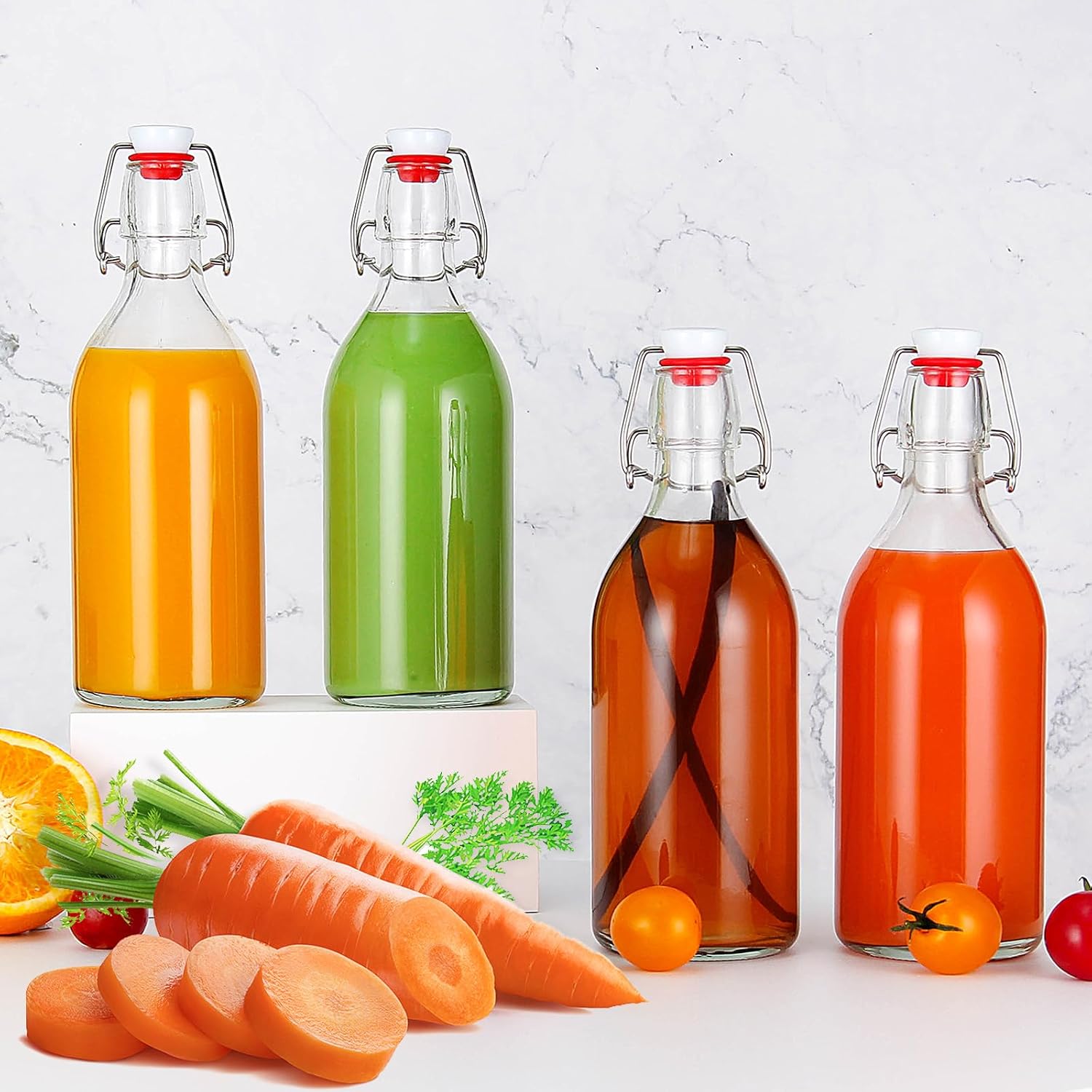
If you’ve ever made your own fizzy drink at home — whether that’s a ginger soda you batch-brewed on the stovetop, a second-fermented kombucha (a fermented tea-like beverage made from sweetened liquid and a SCOBY culture, then bottled to build carbonation), or a homemade root beer — you’ve run into the swing-top bottle question sooner or later. A swing-top bottle is exactly what it sounds like: a glass bottle sealed with a hinged wire bail that clamps a rubber-gasketed stopper down over the mouth. No caps, no corking, no equipment needed. You press it shut, it holds pressure, you pop it open with a satisfying thwack. They’re everywhere on kitchen shelves and craft-soda bars. But here’s the thing most introductory guides skip: not all swing-tops are built for the same job, and the specs that separate a good bottling vessel from a dangerous one (or just a flat-soda disaster) are genuinely easy to decode once someone walks you through them. That’s what this guide does.
If you already know your way around a batch of home soda and you’re trying to decide between a case of Bormioli Rocco Fido jars, a set of EZ Cap bottles, or something heavier-duty from a homebrewing supplier, you’re in the right place. We’ll name the tradeoffs, show the math, and give you a clear decision rule at the end.
The Two Numbers That Actually Matter: PSI Rating and Glass Thickness
Every conversation about swing-top bottles eventually comes down to two specs: rated pressure tolerance (measured in PSI — pounds per square inch, the standard unit for how much internal force a container can handle before it fails) and glass wall thickness (measured in millimeters). Everything else — height, mouth diameter, aesthetic — is secondary if your goal is safe carbonation.
Here’s why those two specs are load-bearing. Live carbonated beverages, especially second-ferment kombucha and naturally carbonated sodas, continue building CO₂ pressure after you seal the bottle. Serious Eats’ science-of-carbonation coverage notes that a typical commercial sparkling beverage sits at roughly 3–4 volumes of CO₂, which translates to about 45–58 PSI at room temperature. Your home ferment can easily exceed that if you misjudge fermentation time or leave bottles at room temperature too long. A bottle rated — or, more accurately, sourced from a manufacturer that publishes structural data — for that pressure range gives you a meaningful safety margin. One that isn’t rated for anything, or that’s made from thinner decorative glass, is a liability.
By the numbers:
| Bottle category | Typical wall thickness | Published pressure range | Best use |
|---|---|---|---|
| Decorative / pantry swing-tops | 2–3 mm | Not rated (avoid for carbonation) | Oils, syrups, dry goods |
| Standard Fido-style jars (Bormioli Rocco) | 3–4 mm | ~30–45 PSI (manufacturer guidance) | Low-carbonation sodas, short ferment |
| Purpose-built EZ Cap / brew bottles | 4–5 mm | ~50–60 PSI (manufacturer guidance) | Active second-ferment, higher carbonation |
| Heavy-duty Belgian-style (e.g., Grolsch format) | 5–6 mm | ~60–75 PSI (some manufacturer specs) | High-carbonation builds, extended cellaring |
Consumer Reports’ glass container review archive notes consistently that wall uniformity matters as much as average thickness — a bottle with uneven walls from poor mold production can fail at the thin spot well below its nominal rating. That’s a reason to buy from established glassware brands rather than unbranded bulk lots, even if the price delta stings.
Gasket Material and the Seal You’re Actually Counting On
The rubber gasket — the small ring seated in the porcelain or plastic stopper — is the part most buyers overlook and most often need to replace. There are three things to check:
1. Material: natural rubber vs. silicone vs. BPA-free synthetic. Natural rubber gaskets are standard on most European-heritage swing-tops (including Bormioli Rocco Fido jars and the classic Grolsch-style bottles). They seal extremely well, but they degrade with repeated heat exposure (dishwasher cycles above 140°F) and can absorb odors over many uses. Silicone gaskets, which appear on some newer American-made and Asian-manufactured bottles, hold up better to heat and don’t pick up flavors, but they occasionally allow micro-leakage at lower pressures if the wire bail tension is slightly off. The Kitchn’s home fermentation guide specifically recommends inspecting gaskets before each bottling run and replacing any that show cracking, flattening, or discoloration — they’re cheap, and a failed gasket means a flat batch at best or a pressure leak at worst.
2. Gasket fit and seat depth. A gasket that sits loosely in its channel — because it’s the wrong diameter for that stopper — will migrate under pressure and lose the seal. This matters most when you buy replacement gaskets from a third-party source. Measure your stopper’s channel diameter before ordering replacements. Most European-standard bottles use a 28–32 mm gasket; some American-made bottles use different sizing.
3. Compression set. Over time, rubber permanently deforms under clamping pressure — this is called compression set. A gasket that’s been compressed in the same position for months without relief will gradually lose its spring and stop sealing reliably. The practical fix: un-latch your bottles for a day or two between batches. It extends gasket life meaningfully.
VinePair’s feature on home fermentation pressure notes that most bottling failures in home-soda setups trace back to gasket failure or inconsistent bail tension — not to the glass itself. That’s a useful calibration if you’ve been treating the glass as the only variable.
Bail Wire Tension and Why “Vintage” Bottles Are a Risk
The wire bail — the metal hinge-and-clip mechanism that locks the stopper down — needs to generate enough compression force to hold the gasket against the bottle lip under your target pressure. On well-manufactured bottles, the bail tension is set at the factory and holds reliably through hundreds of cycles. On worn, older, or poorly made bottles, it loosens.
This is the quiet problem with vintage swing-top bottles — the kind you find at estate sales, antique markets, or decorative housewares shops. They look exactly right. The glass is often thick and beautiful. But the bail wire may have fatigued over decades of use, the gasket is certainly shot, and the bottle lip may have chips or micro-cracks from prior use that aren’t visible to the naked eye. Ball / Newell Brands’ home fermentation FAQ is direct on this point: they do not recommend reusing any glass container for pressure applications if its pressure history and structural integrity are unknown. Replacement gaskets can restore the seal, but you can’t restore wire tension or assess invisible glass stress without equipment.
If you’re drawn to vintage aesthetics — and honestly, a classic amber swing-top bottle on a bar cart does look great — the practical move is to use genuine vintage pieces for décor or for still (non-carbonated) beverages, and buy new bottles for anything you’re carbonating under pressure.
Volume: The 16 oz vs. 32 oz Decision
This is more of a workflow question than a spec question, but it’s worth framing explicitly because the answer changes depending on what you’re making.
16 oz (500 mL) bottles are the dominant format in home soda and kombucha bottling for good reasons: they carbonate more evenly because there’s less headspace variation bottle to bottle, they’re easier to burp and test during active fermentation, and a failure (over-carbonation, off-flavor) costs you one serving rather than a quart. The Kitchn’s home soda guide recommends the 16 oz format as the default for beginners and for any recipe where you’re still dialing in fermentation timing.
32 oz (1 liter) bottles make sense when you’ve nailed a recipe and you’re batching for events or for beverages with very predictable carbonation levels — still fruit sodas, for instance, where you’re force-carbonating rather than relying on active fermentation. The pressure dynamics are similar, but a mistake is twice as expensive per bottle, and larger bottles are harder to store consistently cold (which matters a lot for stopping active fermentation).
There’s no functional reason to use anything larger than 1 liter for home carbonation. The math on pressure distribution doesn’t improve, and the handling risk goes up.
The Decision Rule
Here’s the “if X, then Y” frame for the choices most practitioners are actually facing:
If you’re making naturally carbonated kombucha or sodas with active yeast (second ferment, no force carbonation), then you need a purpose-built brew bottle rated to at least 50 PSI — the EZ Cap format or a heavy Belgian-style bottle. Do not use Fido jars or decorative swing-tops for this. The pressure window during an active second ferment is genuinely unpredictable, and the consequence of under-spec glass isn’t just a flat batch.
If you’re making low-carbonation sodas — lightly sparkling fruit sodas, water kefir with a short second ferment, beverages where you’re targeting 1–2 volumes of CO₂ rather than 3–4 — then a Bormioli Rocco Fido jar or similar 3–4 mm European glass is a reasonable choice and a more economical one. Just keep them cold once sealed and don’t let them sit at room temperature for extended periods.
If you’re force-carbonating (using a CO₂ tank and carbonation cap, then transferring to swing-top for serving), then glass thickness matters more than pressure rating, because you control the carbonation level precisely and you’re not managing active fermentation pressure. A 4 mm bottle in good condition handles standard sparkling-beverage CO₂ levels with comfortable margin.
On gaskets: replace them every 12–18 months regardless of visible condition if you’re running regular batches. They’re inexpensive. A gasket failure mid-batch costs you far more in time and ingredients than a proactive replacement schedule ever will.
On sourcing: buy from established glassware or homebrewing suppliers — brands like Bormioli Rocco, EZ Cap, or similar manufacturers with documented specs — rather than unbranded bulk listings. The price difference on a case of 12 bottles is usually $10–$20. The spec reliability difference is significant.
The bottles themselves are not the exciting part of home soda. Getting the ferment right, dialing in the flavor, sharing something genuinely delicious — that’s the point. But the bottles are the infrastructure, and infrastructure that fails ruins the work that went into everything upstream. Read the specs, replace the gaskets, and then get back to the interesting part.