Ginger beer is a carbonated soft drink brewed (or blended) with real ginger root — not to be confused with ginger ale, which is typically just flavored soda water with minimal real ginger. That distinction matters here, because the question this article is really answering is: when your stomach is doing something unpleasant, does ginger beer actually help, and if so, which brand should you be reaching for? A lot of buyers arrive at ginger beer through cocktails — it’s the fizzy half of a Moscow Mule — and then discover, almost accidentally, that it also soothes an upset stomach. This guide pulls together what hundreds of verified purchasers and long-run reviewers actually report about the top ginger beer brands, with a specific eye on digestive comfort, real-ginger intensity, sugar content, and the logistical headaches (yes, broken bottles) that keep coming up in the data. If you’re already deep into the ginger beer category, we’ll name the tradeoffs directly and help you decide which brand earns the pantry slot.
| EDITOR'S PICKFentimans Sparkling Ginger Beer… | Mid-tierFever-Tree Ginger Beer – Premiu… | Budget pickQ GINGER BEER with Real Ginger… | |
|---|---|---|---|
| Pack size | 12 | 24 | — |
| Bottle/can size | 9.3 fl oz | 6.8 fl oz | 7.5 fl oz |
| Non-alcoholic | ✓ | — | — |
| Sweetener | — | — | Organic agave |
| Calories | — | — | 80 per can |
| Added flavors | Herbal extracts | — | Real ginger |
| Price | $44.99 | $36.72 | $20.94 |
| See on Amazon → | See on Amazon → | See on Amazon → |
Does Ginger Beer Actually Help an Upset Stomach — and What Do Buyers Say?
Let’s get the science on the table first. Healthline’s overview of ginger and nausea relief cites consistent clinical evidence that ginger root compounds — primarily gingerols and shogaols — do have measurable anti-nausea effects. The important caveat: most studies use concentrated ginger extract or raw ginger, not the diluted amounts in a commercial carbonated beverage. So “ginger beer settles my stomach” is probably partially true, partially placebo, and partially the effect of any carbonated liquid on nausea (carbonation alone has a mild calming effect on gastric motility, per the same Healthline guidance).
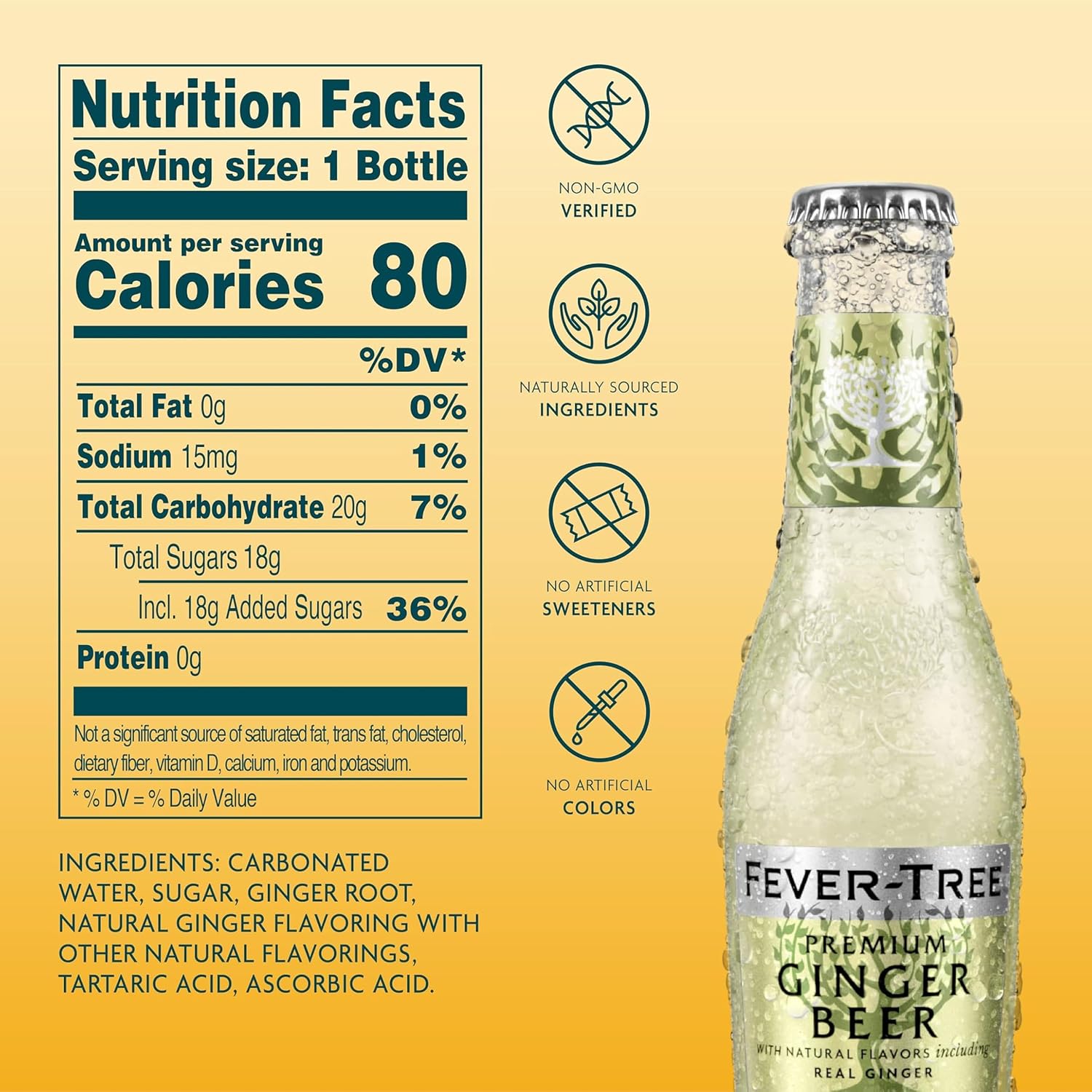
Here’s where the buyer data gets interesting. Across aggregated reviews for Fever-Tree Ginger Beer — one of the highest-reviewed premium bottles in the category — the word comfort appears with unusual frequency. Reviewers explicitly mention keeping cases on hand for morning sickness, motion sickness, post-illness recovery, and general stomach upset. This isn’t a one-off; it’s a documented pattern across hundreds of reviews. Several buyers frame it not as a beverage purchase but as a household health staple, the same mental category they’d put ginger chews or antacids in.
The implication for buyers: the brands with the highest real-ginger content are the ones earning stomach-relief loyalty — and those tend to be the premium, higher-spice options rather than the mass-market bottles.
Brand-by-Brand Breakdown: Where Real Ginger Actually Shows Up
Fever-Tree Ginger Beer
Fever-Tree has built its reputation on three ginger varieties sourced from the Ivory Coast, Nigeria, and Cochin, India. VinePair’s explainer on ginger beer production notes that multi-origin ginger blending produces a more complex heat profile than single-source formulas. Reviewers consistently back this up: the heat is described as warming and sustained rather than sharp or artificial.
For the stomach-relief use case specifically, Fever-Tree is the category leader in buyer loyalty. The pattern in long-run reviews: buyers initially buy it for cocktails, discover the comfort factor during illness, and then start ordering it in bulk specifically for that purpose. Multiple reviewers explicitly describe it as their “sick-day drink.” The carbonation level is moderate — enough to feel soothing without being aggressively fizzy, which matters when your stomach is already irritated.
The tradeoff: Fever-Tree has seen meaningful price increases since 2023, and several reviewers flag this directly. It remains worth it for most premium buyers, but the value calculation has shifted. Also worth noting: Fever-Tree Blood Orange Ginger Beer earns a niche fanbase, but multiple reviewers honestly admit they can barely distinguish it from standard Fever-Tree on flavor alone. If you’re buying for stomach relief rather than a specific cocktail application, the standard version is the smarter buy.
Q Ginger Beer
Q Mixers occupies a different position in the market: it’s the brand cocktail enthusiasts most often cite for converting them away from mass-market ginger beer. Across aggregated reviews, Q Ginger Beer earns a recurring phrase: “single-handedly renewed my interest in Moscow Mules.” Reviewers consistently call it the spiciest of the mainstream premium options, with a sharper, more peppery ginger hit than Fever-Tree’s rounder warmth.
The real-sugar question: Q uses real cane sugar rather than high-fructose corn syrup, and several reviewers flag this explicitly as a reason for choosing it over other options. Consumer Reports’ guidance on reading carbonated beverage sugar labels notes that real-sugar formulas often produce a cleaner sweetness without the lingering syrupy aftertaste some people associate with HFCS. For the stomach-relief buyer, Q’s higher spice level means more gingerol content — which is theoretically the active compound you want. But the intensity that cocktail lovers prize can feel harsh on a genuinely queasy stomach. If X (using it for a Moscow Mule or flavor-forward experience), Q is probably your answer. If X (using it as a stomach soother during illness), Fever-Tree’s gentler carbonation and rounder heat profile may be kinder.
Reed’s Extra Ginger Beer
Reed’s Extra is the option that comes up most often among buyers who want “real ginger ale” rather than a premium mixer. The label boasts a higher ginger-root concentration than Reed’s standard formula, and reviewers across Tasting Table’s brand comparison feature consistently note that it delivers a more intense, earthy ginger flavor than most mass-market competitors.
One consistently praised operational detail: Reed’s ships individual bottles with wrapping that reduces breakage significantly. For buyers who have been burned by broken-glass arrivals in multipack orders, this packaging choice earns genuine loyalty. Reviewers explicitly mention it as a reason for repeat purchases.
The tradeoff: Reed’s Extra sits at a different price-per-ounce than Fever-Tree or Q, and the brand’s aesthetic is less upscale — which matters if you’re using it as a hospitality mixer. For home stomach-relief use, that’s irrelevant. For boutique bar buyers or event hosts, it may not carry the visual credibility of Fever-Tree’s distinctive bottle.
Fentimans Ginger Beer
Fentimans uses a fermentation-based brewing process — genuinely botanically brewed rather than simply mixed — and has a devoted fanbase that returns repeatedly for its complex, slightly earthy flavor profile. Serious Eats’ ginger beer coverage notes that fermentation-produced ginger beers develop flavor compounds that standard blending can’t replicate.
The recurring complaint: Fentimans bottles use screw-top caps that multiple reviewers — particularly buyers with arthritis or reduced hand strength — describe as frustratingly difficult to open. This is not a minor UX complaint; it shows up consistently enough across reviews to constitute a genuine accessibility concern. If you or someone in your household has mobility or grip limitations, this is worth weighing against Fentimans’ otherwise excellent flavor reputation.
Cock ‘n Bull Ginger Beer
Cock ‘n Bull is the category’s most interesting loyalty paradox. Multiple reviewers report receiving exactly one broken bottle per 12-pack as what feels like an expected occurrence — and then explicitly note that they reorder anyway. That level of flavor loyalty despite consistent logistical frustration is unusual. The brand has strong legacy associations with the original Moscow Mule recipe, and for buyers who care about that historical provenance, it matters. But if you’re ordering primarily for stomach relief or event hosting, a predictable breakage rate is a real operational cost.
By the Numbers
| Brand | Ginger Intensity (reviewer consensus) | Best Use Case | Notable Friction |
|---|---|---|---|
| Fever-Tree | Medium-warm, rounded | Stomach relief, cocktails, hospitality | Price increases since 2023 |
| Q Ginger Beer | High, sharp/peppery | Flavor-forward cocktails | Too intense for queasy stomachs |
| Reed’s Extra | Medium-high, earthy | Everyday health use, bulk stocking | Less visual prestige |
| Fentimans | Complex, fermented | Flavor enthusiasts | Difficult screw caps |
| Cock ‘n Bull | Classic, balanced | Legacy cocktail applications | ~1 broken bottle/12-pack |
Is Fever-Tree Light Worth It for Low-Sugar Drinkers?
This comes up frequently enough to warrant direct treatment. Fever-Tree Light uses a reduced-sugar formula while maintaining the same ginger blend. Reviewers generally report that the flavor profile is preserved reasonably well — the ginger heat is similar — but that the sweetness reduction is noticeable in a way that affects balance, particularly in cocktails where the ginger beer’s sugar is part of the flavor equation.
For diabetics or buyers actively managing sugar intake, Fever-Tree Light is a legitimate option, and it’s the premium alternative that reviewers most often recommend over artificially sweetened options. Consumer Reports’ label-reading guidance notes that many low-sugar carbonated beverages substitute sugar alcohols or artificial sweeteners that can have their own digestive side effects — particularly relevant if the reason you’re drinking ginger beer is stomach discomfort in the first place. Fever-Tree Light avoids that tradeoff. If X (managing blood sugar, still want the mixer experience): Fever-Tree Light is the call. If X (purely seeking maximum ginger-root concentration for nausea relief): standard Reed’s Extra gives you more ginger content per serving.
Why Do Glass Ginger Beer Bottles Break So Often in Shipping?
The short answer: glass + carbonation pressure + standard parcel handling is a genuinely difficult combination. Amazon’s fulfillment network was not designed around fragile glass multipacks, and the physics are unforgiving — a 12-pack of glass bottles creates stress points at every corner of the box. Cock ‘n Bull’s breakage pattern is the most documented example, but it shows up across almost every glass-bottle ginger beer brand to some degree.
Practical decision rule: If X (ordering glass-bottle ginger beer in bulk), look for brands or listings that explicitly note individual bottle wrapping — Reed’s Extra is the most praised example of this. Alternatively, factor one broken bottle per case into your effective price-per-unit when comparing glass vs. can format options from the same brand.
Frequently Asked Questions
Is ginger beer actually good for nausea and upset stomachs? Per Healthline’s overview of ginger’s anti-nausea properties, real-ginger compounds do have documented effects on nausea — but commercial ginger beer contains far less ginger root than clinical studies use. That said, buyer reports are consistent: real-ginger premium brands (Fever-Tree, Reed’s Extra) produce measurable comfort responses for many users. The carbonation itself may also help. It’s not a replacement for medication, but it’s not nothing.
Which ginger beer has the strongest real-ginger flavor? Across reviewer consensus, Q Ginger Beer earns the “spiciest mainstream option” designation most consistently, with Reed’s Extra a close second for earthy ginger depth. Fever-Tree is more rounded and approachable.
Is Fever-Tree Light worth it for diabetics or low-sugar drinkers? For buyers managing blood sugar who still want a premium mixer experience, yes — it preserves the flavor profile better than artificially sweetened alternatives. For maximum ginger-root concentration, standard Reed’s Extra is a stronger choice.
Why do so many glass ginger beer bottles arrive broken from Amazon? Glass bottles under carbonation pressure are fragile in standard parcel shipping. It’s a category-wide issue, not brand-specific. Reed’s Extra’s individual bottle wrapping is the most buyer-praised solution. Factor ~1 broken bottle per 12-pack into your cost math for glass-format orders.
How does Q Ginger Beer compare to Fever-Tree for Moscow Mules? Q earns higher praise for sheer spice intensity and cocktail punch. Fever-Tree produces a more balanced, hospitality-friendly result. Serious cocktail enthusiasts tend to prefer Q; event hosts and buyers serving mixed-preference crowds tend to prefer Fever-Tree.
Does Fever-Tree Blood Orange actually taste different from regular Fever-Tree? Reviewers are honest about this: the blood orange distinction is subtle to the point of being imperceptible to many drinkers. If you’re buying for a specific flavor application, the standard version delivers comparable results at a lower per-bottle cost given current pricing.